No sensors. No wires. No strobe. Just your iPhone against the motor.
Stethoscope It keeps the last 15 seconds of sound, so you can hear the bearing at 1/32 speed.
Free to measure. Stethoscope $19.99, one purchase. iPhone, iOS 17 or later.
Works on most single- & three-phase AC induction motors.
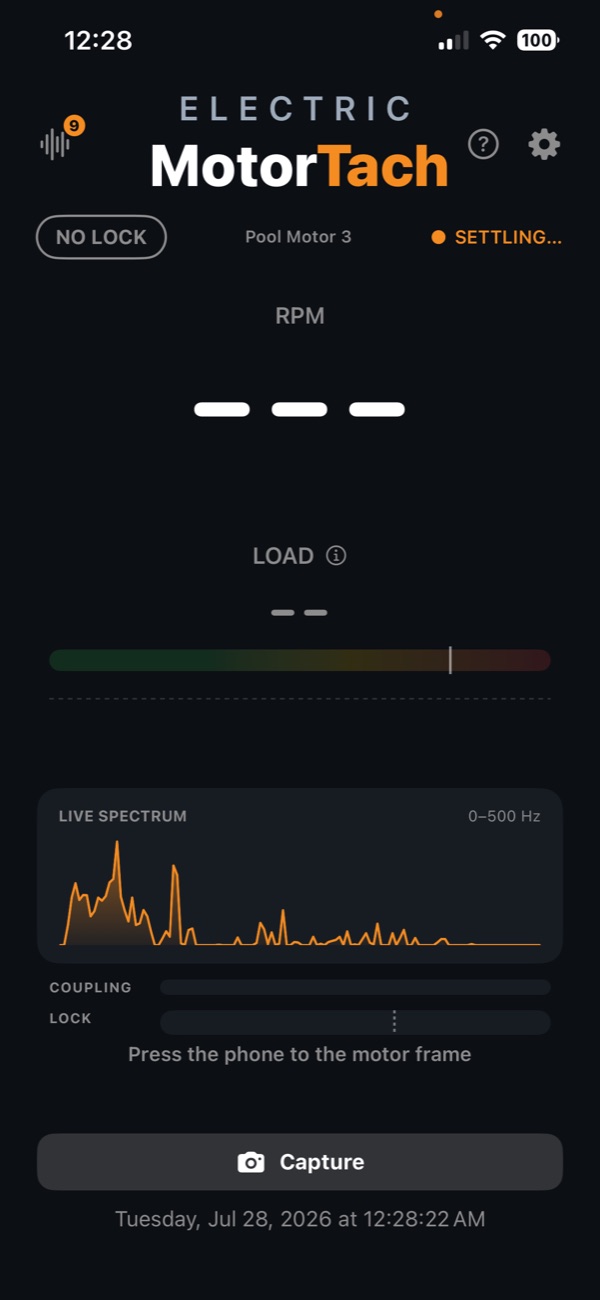
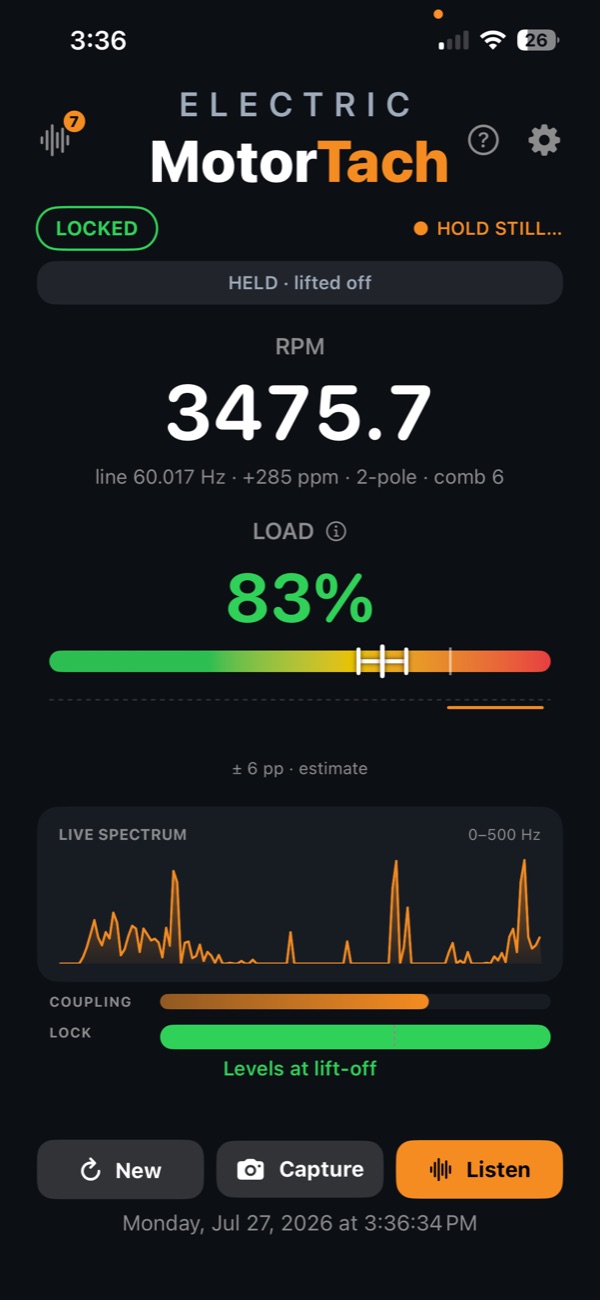
Touch the motor → settles → locks in seconds
MotorTach uses the microphone in your iPhone's bottom corner as a contact microphone, reading the sound a motor sends through its own frame and turning it into a precise speed and load reading. All of it is deterministic signal processing on the phone: no machine learning, no cloud, no network.
Hold the bottom corner of your iPhone flat against the center of the motor housing.
MotorTach settles on the running frequency and locks in, and you'll see the status pill turn to LOCKED.
Get exact RPM, estimated load, and a live spectrum. Lift the phone off with a slight jerk and twist and the reading freezes on screen, so you can read it away from the machine.
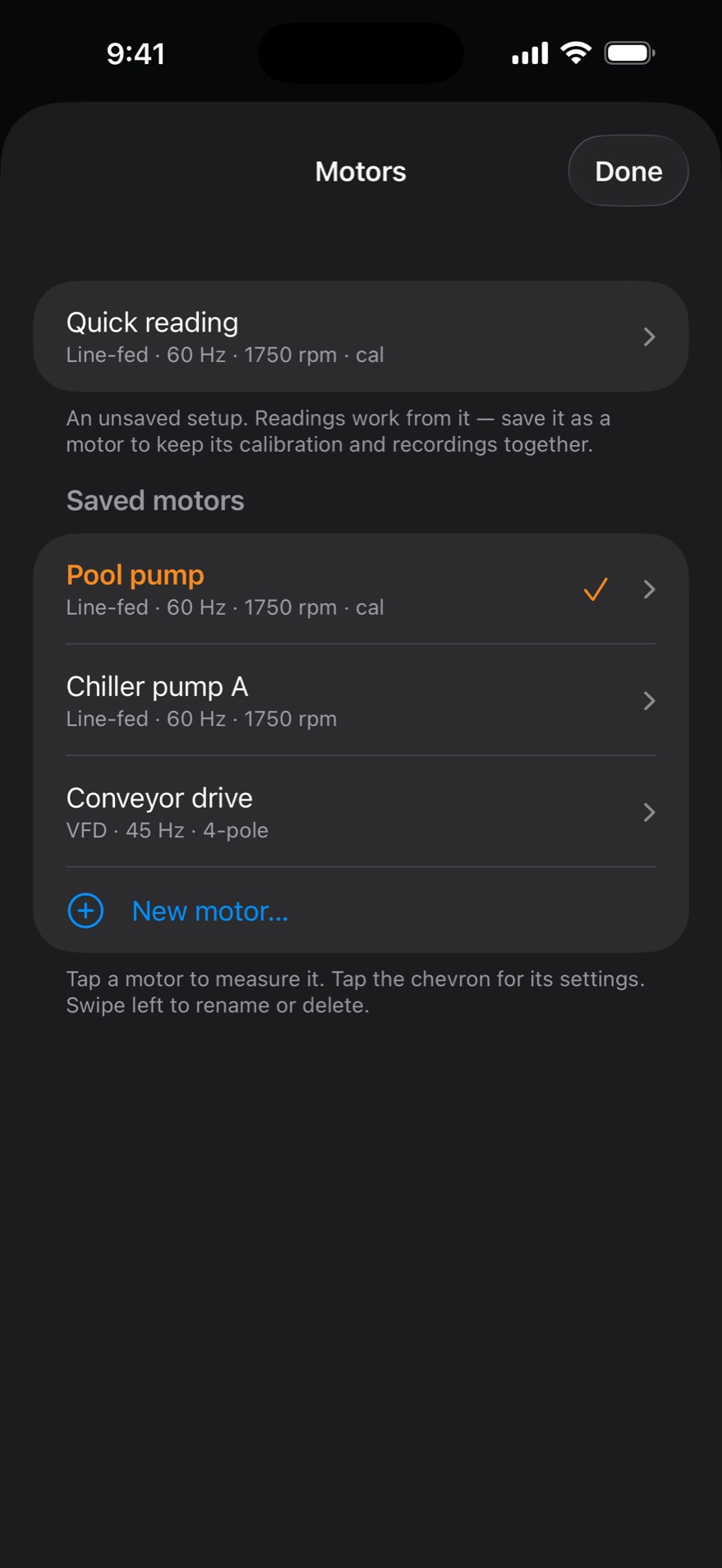
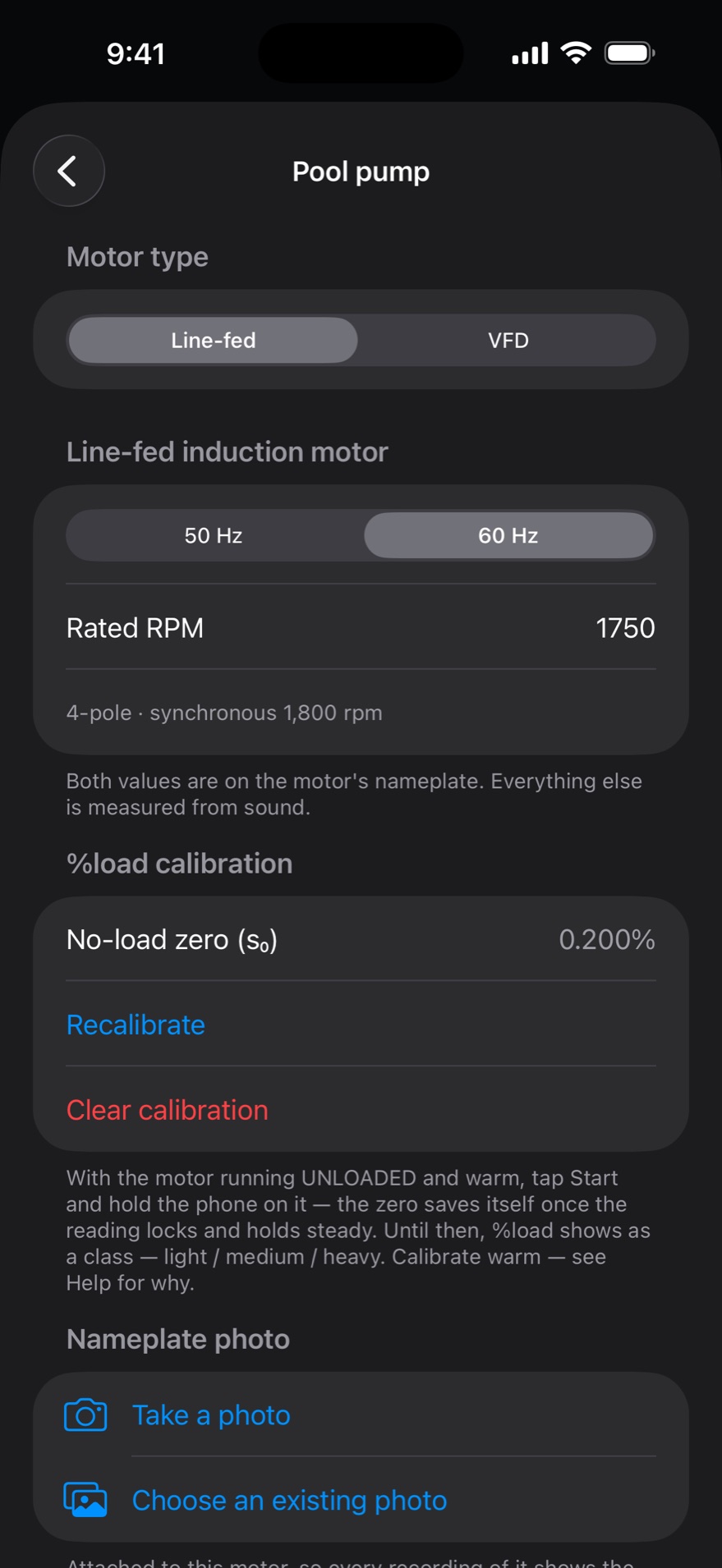
MotorTach needs the supply frequency and the rated RPM, both printed on the plate. Pole count and synchronous speed are worked out from those, and everything else is measured from the sound. In a hurry, a quick reading takes the values without naming a motor, so a first reading never waits on paperwork.
Anyone who's checked a motor the old way knows the routine: pull the cover off the box, work around live terminals, and try to get a reading without getting too close to the voltage. MotorTach reads it all from the outside of the motor. Touch the housing and you've got the speed and how hard it's working, with the electrical box left shut and your hands away from the current.
MotorTach is an indication, not a protection device. Don't use it as the basis for a safety decision.
MotorTach shows the numbers that matter, without the guesswork of a handheld strobe or the shaft access a mechanical tachometer needs.
No reflective tape, no strobe, no external probe. Just touch the motor and read.
Settles and locks in seconds. Give it about five seconds of steady sound and it reads to about 1 RPM on a line-fed motor.
Speed and load side by side, so you understand what the motor is actually doing.
A real-time 0–500 Hz view helps you catch roughness and irregular running.
Save timestamped readings to document commissioning, service calls, and rounds.
One less tool on the truck. If you have your iPhone, you have a tachometer.
Every reading keeps its last 15 seconds of sound. Play it back as slow as 1/32 speed and listen to the machine the way you would through a stethoscope, except you can slow time down while you do it.
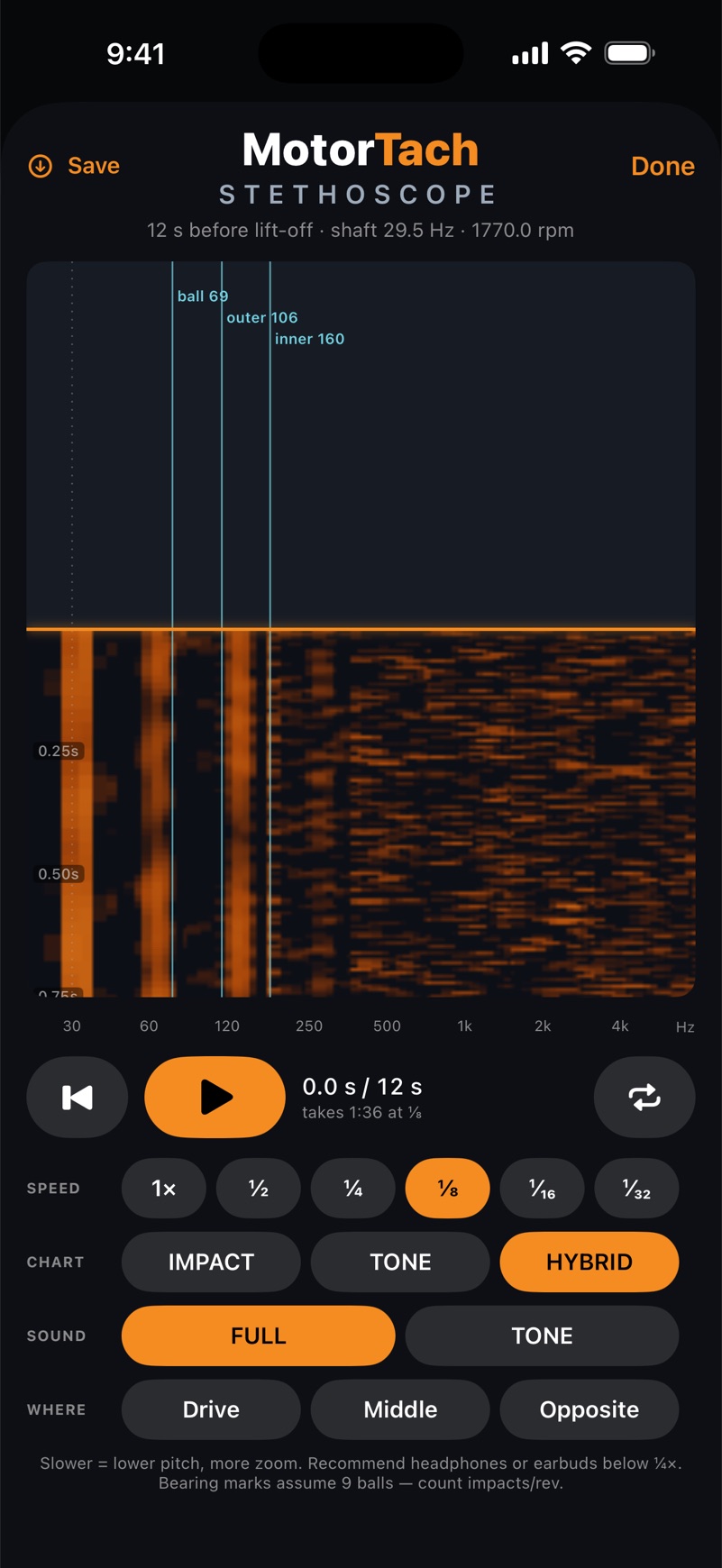
Down to 1/32 speed, this is a real tape slowdown rather than a time-stretch. An impact stays an impact instead of being smeared into a smudge, which is the whole point when what you are listening for is something hitting once per revolution.
A constant-Q waterfall shows where the energy actually sits, with cage, ball, outer-race and inner-race marks scaled from the speed MotorTach just measured. You are not guessing which line is which.
TONE plays the machine's rhythm on a steady note that holds its pitch however far you slow it down. A wobble stays audible even after the real frequency has dropped below anything a phone speaker can reproduce.
The chip measures how impulsive the 2–10 kHz band is: whether anything up there is hitting rather than hissing. These four recordings ship inside the free app, so you can hear the difference before you ever find a machine.
The same machine in good order. This is what SMOOTH sounds like.
SMOOTH 3.0First stage of an inner-race defect, 0.007 in.
TICKING 6.0The same defect grown to 0.014 in. Compare the chip with the healthy one.
IMPULSIVE 22.5Same bearing, outer race, 0.021 in. Listen in TONE and you can hear the wobble.
IMPULSIVE 25.2A screening indicator, not a diagnosis. The chip is for noticing a machine getting worse over time, not for certifying one as healthy. And here is the part nobody advertises: once a race is worn rough all over, the impacts blur back into a hiss and the number falls again, so a late-stage bearing can read green. A single number can mislead you. A history is much harder to fool. The chip has also not yet been validated against a genuinely failed bearing in the field. And look at that fourth card: as bad as that bearing is, MotorTach still refused to print a speed it could not stand behind.
That is exactly why you take it. A bearing chip on its own is a screening number. The same machine recorded again in six months is a trend, and the trend is the thing that tells you something is going. Record every motor while it is running fine, and you have built the yardstick you will need the day one of them is not.
Readings group by machine, then by measurement point on that machine, then by date.
The reading, the motor's setup, the audio, a note, a photo of the nameplate, and the bearing chip.
Record the same machine at each measurement point and keep them side by side.
Audio, a plain-text summary and the diagnostics log, ready to mail to whoever needs it.
Single-phase or three-phase, MotorTach reads most line-powered AC induction motors through contact with the frame. It locks on best with constant-speed motors, the kind that run at a steady RPM straight off the power line.
Air handlers, RTUs, condenser and cooling-tower fans.
Water, wastewater, irrigation, circulation and booster pumps.
Rotary screw air and refrigeration compressors.
Building exhaust, fume hoods, and process fans.
Belt and roller drives in material handling.
Lathes, mills, grinders, saws and some bench equipment.
Irrigation pumps and grain-aeration fans.
Circulation pumps and aeration blowers.
A note on three-phase. MotorTach is built for three-phase motors and the physics is no different from single-phase. But every reading I have taken in the field so far has been on single-phase equipment, so if you run it on a three-phase machine I would genuinely like to hear how it went. The app's Help section has a way to send me the reading.
A note on VFD-driven motors. VFD support is BETA. Motors running on a variable-frequency drive change speed as the drive commands them, so they can be harder to lock onto and sync with. There's a setup step too: on a drive you enter the drive's panel frequency and the motor's pole count by hand. Treat a VFD reading as provisional and check it against the drive's own display where there is one. MotorTach is happiest on line-fed, constant-speed motors, though it's always worth a try. If it can't read your VFD-driven motor, the app's Help section has a way to send me the failure report, which helps improve the app. There is no substitute for field feedback.
What MotorTach can't read. Synchronous, brushless DC, DC, universal and stepper motors are all outside what it measures. So are small residential fan motors, a home air conditioner's condenser fan among them, whose slip runs far higher than the range MotorTach searches. The HVAC equipment above is the commercial kind: air handlers, RTUs and cooling towers.
Popular with HVAC technicians and municipal water & wastewater teams, and useful anywhere a motor needs a quick speed check.
Free lets you hear what a failing bearing sounds like. The Stethoscope lets you hear what yours sounds like, and remember it.
No account. No cap. No trial counting down.
One purchase, once. Not a subscription.
$0 in extra hardware, either way. No reflective tape, no strobe, no probe, nothing to charge and nothing to leave behind in the truck.
MotorTach is launching on the App Store, Stethoscope and all. Leave your email and we'll tell you the day it's live, so you can start recording your machines while they are still running fine.
iPhone, iOS 17 or later.
